
November 20, 2019
Ashly Cork

Many of us can admit guilt to having preconceived notions when we think about technology; we imagine the jobs that exist in the ‘tech’ field, and in our minds, computers pop up almost immediately, alongside more specific vocations such as programming, data analytics and software engineering. Amongst some other persons, the stereotype still exists that tech jobs belong mostly (or only) to males; that STEM is not a field that females can or should thrive in. According to a UNESCO Report (2018), 45.4% of females made up the numbers of those employed in scientific research and development for the Latin America and Caribbean region. As this number grows, women are increasingly challenging these gendered stereotypes. In Jamaica, Tech Diva Ja, a collection of Jamaican women working in what they call the ‘technical arts’, have done their best to be a catalyst for a change in the ways that technology and women are viewed.
On Sunday, October 27, Tech Diva Ja in association with the British Council, Ministry of Culture, Gender, Entertainment and Sport and JCDC, hosted the event, Our Heroes: Walking in Their Light. This event took place towards the closing of the celebrations for National Heroes’ Day. Through this event, the team took on the task of lighting up the monuments in National Heroes Park. Nadia Roxburgh, lighting expert and member of Tech Diva Ja, will describe the ways that filling a space with light can be a form of communication and beautification. Different colours psychologically represent different things to us when we see them, and in using varying light to fill a space we are able to force an audience to feel different things, whether that is a seated audience watching a dance show on stage or an audience walking through a park seeing the statues of their national heroes lit up.
This event and Tech Diva Ja being the force behind the success of the event, represented a change in the way we have been socialised to think about opportunities in technology.
Last year, Government Ministers and Policy-Makers pleaded for more women to pursue jobs in Science, Technology, Engineering and Mathematics (STEM). The theme locally for last year’s 2018 International Women’s Day (IWD) was, “Empowering Women and Girls in Science, Technology and Business.’ The debate has always been if this under-representation is really a side-effect of socialised norms or if it is simply a case of self exclusion from these fields by the women themselves. Both arguments may hold some weight but one must always consider that self exclusion could be based on the domino effect of socialised norms causing women to feel discouraged to tread in waters that they are taught they would not be able to manage. Whatever the underlying reasons may be, there has been a shift in the conversation with more encouragement being given to women to break through this glass ceiling.
For further data, engineering, one field under the broad banner of technology, had approximately 10% enrolment rates overall for females at the University of the West Indies, Mona Campus and 18% at the University of Technology- both recorded for the 2015-2016 academic year. But what is important here is to think passed technology as simply someone using a device to create programmes and applications, or engineers who build things from scratch by whatever instruments they can manipulate to create a final structure. The opportunities in technology today are far more vast than we have been exposed to regularly and Tech Diva Ja has done a good job at highlighting this through their movement.
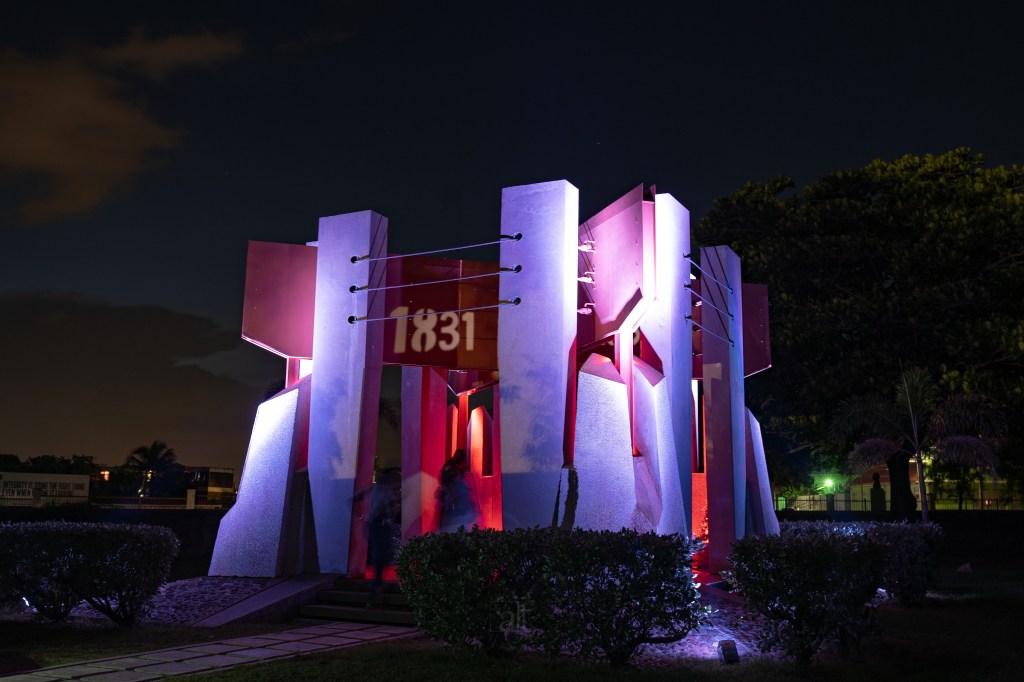
For the lighting up of the monuments at the National Heroes Park, Tech Diva Ja, with help from participants from the British Council’s Backstage to the Future project, used wireless up lights to bring new meaning and dimension to these art pieces. They placed the lights in different corners and crevices of the monuments, shining down the colours in various angles to enhance the stories that the original artists may have wanted to portray and a new story with the help of light.

The monument of the Rt. Excellent Samuel Sharpe, designed by Compass Workshop Ltd, was originally created to tell the story of passive resistance, Nadia stated. For the event, the monument was decorated with various important dates, which were stencilled out on paper and put in front of lights to cast the shadow of the number on the walls of the monument, dates such as 1831, the date Sharpe orchestrated his infamous rebellion was one such decoration. The inside of Sharpe’s entire monument was lit with red, which psychologically can portray blood, danger and even anger to the audience.
Another monument, that of the Rt. Excellent Marcus Mosiah Garvey, originally designed by G.C. Hodges in 1964, was coloured red and green, key colours for both Marcus Garvey’s movement in the 1900s and the Rastafari movement today. These colours represent the blood shed by our ancestors and the vegetation to come in the promised land. For those who align themselves with this movement, seeing this monument lit up in these colours would have a different level of emotion and significance to them as the audience as it would to someone who does not understand what the colours represent.

This event took technology to a different level. It took it outside and away from a desk, without any wires. It brought colour and dimension to an otherwise monotonous conventional image of technology and a physical space that is otherwise void of colour and light itself. Most importantly, in the spirit of heritage month, it celebrated our national heroes, it literally lit them up in a way they had not been seen before, it brought tons of outsiders to a space often forgotten but nonetheless still of great importance. And much like other cities who use lights to beautify their nightlife, almost everyone you passed by at the event had the resounding opinion that, “they should leave it like this every night.”
It is extremely important for us to be disrupters of antiquated social norms. It is important to have people to remind us that many of the things we have been socialised to believe have placed us in boxes we need not exist in. Tech Diva Ja has taught us, through this one event and through years of experience, that not only is the field of technology extremely multifaceted in the ways you can succeed from it, but it does not have to look like nerdy men in suits around a computer. There is space for women to exist in rooms they were taught they do not belong in, and there is space for us to use both creativity and technology together because separating the two limits us from a world of opportunities that we cannot afford to pass us by.
The creative economy is booming worldwide and in Jamaica today, and we must continue looking at ways collaboration can allow us to grow our economy. Creativity and technology, while they may not usually find themselves in the same sentences, cannot exist without one another.
Follow @TechDivaJa for more updates on the projects these ladies are working on.
Also, learn more about the British Council’s Backstage to the Future Project here: https://www.britishcouncil.org/cultural-skills-unit/projects/backstage-future-caribbean-2017
 Jamaica Creates
Great work Jamaica’s Women of Light!!! Thanks Nadia for letting me know about the project I will expose it to some of my “friends..”I’m proud of you all.
“LIVE WELL AND PROSPER!”
Love .
Dot Malin
Israel.
LikeLike